$STICK
Participatory Memes as Cultural Infrastructure: A Case Study of Stick Nation and Its Implications for Cultural-Asset Valuation

Keywords: participatory culture, internet memes, network effects, digital communities, cultural valuation
Abstract
This paper examines participatory memes — recurring cultural practices that convert audiences into contributors — as a distinct and under-studied form of digital cultural infrastructure. Using “Stick Nation” (the community around the account Official Stick Reviews, active since August 2023) as a case study, we compile publicly reported engagement and contribution metrics from major outlets and platform data, and situate the case within the literature on participatory culture and network effects. We distinguish participatory memes from image-circulation memes along a single axis — the distance between spectator and participant — and argue this axis predicts a larger and more durable cultural surface area. We then treat the crypto “memecoin” market as a natural, if noisy, revealed-preference experiment in what participants will pay for cultural symbols, and ask whether pre-existing participatory infrastructure correlates with valuation outcomes. We report descriptive findings only; we do not establish causation, and we make no forecast of any asset’s value. The contribution is a testable framework and a documented case, not an investment recommendation.
Introduction
A stick is one of the oldest objects a human can hold: a tool, an open-ended toy, and a surface for projection at once. It is immediately recognizable yet never fully prescribed — in one hand a sword, in another a wand, a walking staff, a dog’s prize, or the memory of a day outdoors. Pick one up and it stops being debris; the material barely changes, but the meaning does. It is familiar enough to grasp instantly, yet unfinished enough for anyone to complete.
That small transformation - from object to meaning - is the starting point of this paper. Most accounts of internet memes treat them as images that circulate: a frog, a dog in a hat, a screenshot. Under this model a meme’s reach is a function of how many people repost a fixed artifact. This paper is concerned with a different structure, which we call the participatory meme: a repeatable ritual in which the artifact is produced anew by each participant. The research question is narrow and stated up front:
RQ1. Do participatory memes exhibit measurably different growth and retention characteristics than image-circulation memes? RQ2. Is the presence of participatory cultural infrastructure associated with the market valuations observed for related cultural assets?
We approach RQ1 through a single, unusually legible case, and RQ2 through a descriptive comparison against a market that has repeatedly assigned large valuations to cultural symbols. Section 2 reviews relevant literature; Section 3 states the method and its limits; Section 4 reports the case data; Section 5 develops the analysis; Section 6 catalogs threats to validity; Section 7 concludes.
Background and related work
2.1 Human attachment to shaped wood
The affinity for shaping and displaying found wood is old. At Kalambo Falls, Zambia, archaeologists recovered intentionally worked wood — including interlocking logs joined by a cut notch — from deposits dated to at least 476,000 ± 23,000 years ago, predating our own species [1]. The archaeological record for wood is sparse because wood rarely survives, so this is a claim about depth of relationship, not about a “first tool.” It is included here only to establish that the object at the center of the case is culturally load-bearing rather than arbitrary.
2.2 Participatory culture and network effects
Prior work on participatory culture describes communities with low barriers to contribution, strong support for creating and sharing, and informal mentorship from experienced to novice members. Separately, the network-effects literature holds that the value of a network can grow super-linearly with participation. Our framing joins the two: a meme whose “content” is a user-generated act, rather than a fixed file, should accrue the compounding properties of a participatory network rather than the decay curve of a viral image.
Data and method
This is a descriptive, single-case study. Figures were compiled from English-language press coverage [2,3,5], the community’s public platform profiles [4], and a trade-press report of a creator-estimated archive size [6]. Where a figure is self-reported by the creators (for example, submission counts and archive size), it is labeled as such and not treated as independently audited. Market-capitalization figures in Section 4.3 are drawn from public trackers and are used only as order-of-magnitude comparators; they are volatile and should be re-verified before any downstream use. We deliberately avoid inferential statistics: with one focal case and a small, non-random comparison set, the appropriate output is a documented description and a falsifiable framework, not a significance claim.
Findings
4.1 Scale of the community
As of August 2026, Official Stick Reviews reported approximately:
- 3.34M Instagram followers, across 5,030+ posts
- ~1M TikTok followers
- 313K Facebook followers
- An archive of ~1 terabyte of submissions (creator-estimated, self-reported) [6]
- Combined cross-platform reach reported at roughly 4.5M as of October 2025 [3]
The growth trajectory is steep: roughly 14,000 followers by Christmas 2023, reaching approximately 3 million within one year [2]. An independent April 2024 interview cited 43,000 followers at that point [5], consistent with acceleration through spring 2024. Reported cumulative reach necessarily understates true exposure, since it excludes views on non-followed and re-shared content.
4.2 Contribution, not just attention
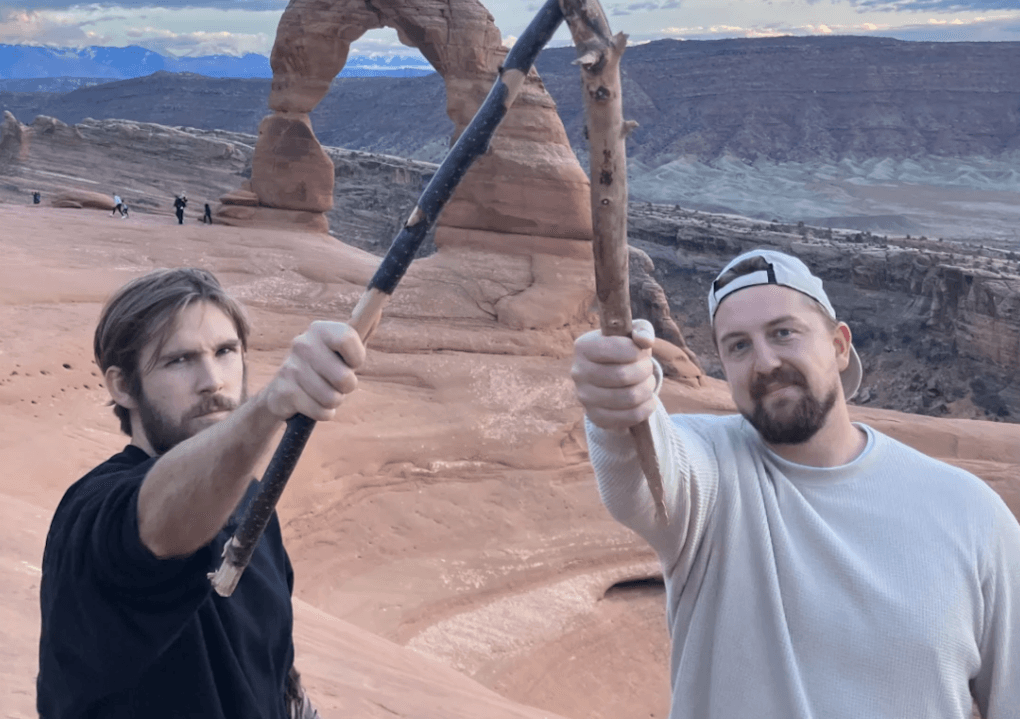
The distinguishing signal is contribution. By January 2025 the creators reported roughly 100,000 submissions, arriving at hundreds per day from a community spanning 120 countries [2]. In October 2025 a founder described 100–200 submissions per day, of which about 4,000 had been published [3]. Participants do not merely watch: they search their surroundings, interpret what they find, record it, and submit it for recognition. This is the behavior the framework in Section 5 predicts.
4.3 Market comparators
Table 1 lists approximate peak valuations for a non-random set of culturally-derived crypto assets. These are illustrative order-of-magnitude figures from public trackers, not audited valuations, and several rest on far less pre-existing participatory infrastructure than the case community.
| Token | Approx. peak market cap | Pre-existing cultural infrastructure |
|---|---|---|
| PEPE | ~$11.5B | Established image meme; no real-world antecedent object |
| dogwifhat (WIF) | ~$4.8B | Derivative of an existing photo / dog meme |
| BONK | ~$4.4B | Solana ecosystem incentive token, not originally media-driven |
| FARTCOIN | ~$2.5B | Pure joke token; no underlying community property |
| PNUT | ~$2.47B | Event-driven (a single news cycle) |
| Just a chill guy | ~$500M–$650M | Single static image meme |
Table 1. Approximate peak market capitalizations of selected culturally-derived tokens. Figures move quickly and are provided for scale only.
Discussion
5.1 Instant legibility
The strongest memes need almost no explanation. Recognition of a remarkable stick does not depend on language, age, nationality, or subculture, and submissions have come from more than 120 countries [2]. A maximally legible meme therefore begins with a larger addressable audience than most crypto-native symbols.
5.2 Ritual over virality
Virality captures attention once; ritual produces recurrence. Stick Nation runs a repeatable loop — find, submit, review, rank, debate, share, find again — in which every stage generates its own content. The distance between spectator and participant is unusually short: a person can walk outside, find a branch, and submit it within minutes. This is the mechanism we argue separates participatory memes from image-circulation memes, and it maps directly onto the network-effects framing of Section 2.2.
5.3 Community-generated supply
Because the raw material is free, globally distributed, and continuously replenished, the community operates on near-zero-cost user-generated content with effectively unlimited inventory [3,6]. New finds, national rivalries, and edge-case debates (does an icicle count?) emerge organically. Structurally, this resembles optionality on a stream of future cultural moments rather than a bet on a single punchline. Relative to Table 1, the case community exhibits more pre-existing participatory infrastructure than most listed comparators — which is the empirical basis for RQ2, and nothing more.

Conclusion
We have described a participatory meme as a form of cultural infrastructure and documented one case in detail. What is well-supported: the object is ancient and legible, the community is large and international, and its activity is contribution-driven rather than view-driven. What remains open: whether participatory infrastructure is causally associated with the valuations observed in adjacent markets, and whether the pattern replicates. We offer the framework and the case so that both questions can be tested. The object is simple; the questions it raises are not.
Disclosure. This paper is a descriptive academic analysis. It is not financial or investment advice
References
- [1]
Barham, L., Duller, G. A. T., Candy, I., et al. (2023). Evidence for the earliest structural use of wood at least 476,000 years ago. Nature, 622, 107–111.
- [2]
The Guardian. “Stick nation! Why do 3 million people — including me and my kids — love stick reviews?” 31 January 2025.
- [3]
The Washington Post. “How ‘Official Stick Reviews’ turned a humble object into an internet phenomenon.” October 2025.
- [4]
Official Stick Reviews (@officialstickreviews). Instagram, TikTok, and Facebook public profiles. Accessed August 2026.
- [5]
CBC Radio, As It Happens. “Welcome to the wholesome, yet splintered, community of online stick reviews.” 5 April 2024.
- [6]
VICE. “The wild rise of Official Stick Reviews, the internet’s most wholesome weirdos.” 26 November 2025.
- [7]
Hogg, B., & Jugler, L. (2025). Sticks. Ten Speed Press, 176 pp.